

DOG’S MIND — ARTICLES
Dog Sports and Pressure-Based Tools: When Winning Matters More Than the Dog
On pressure in dog sports, competitive success, and the welfare of the dog.
I have often expressed my views on dog training when a behavior may put a human life or an animal’s life at risk. When the safety of a family, a child, or the dog itself is at stake, I will not hesitate to apply pressure if the circumstances make it necessary. I do not believe in rigid methodological dogmas that disregard the seriousness of a behavior and the real-world conditions in which it occurs.
Dog sports, however, are an entirely different matter. They are not about responding to an immediate danger. They are activities chosen by humans, with rules, scores, and distinctions that serve human ambitions.
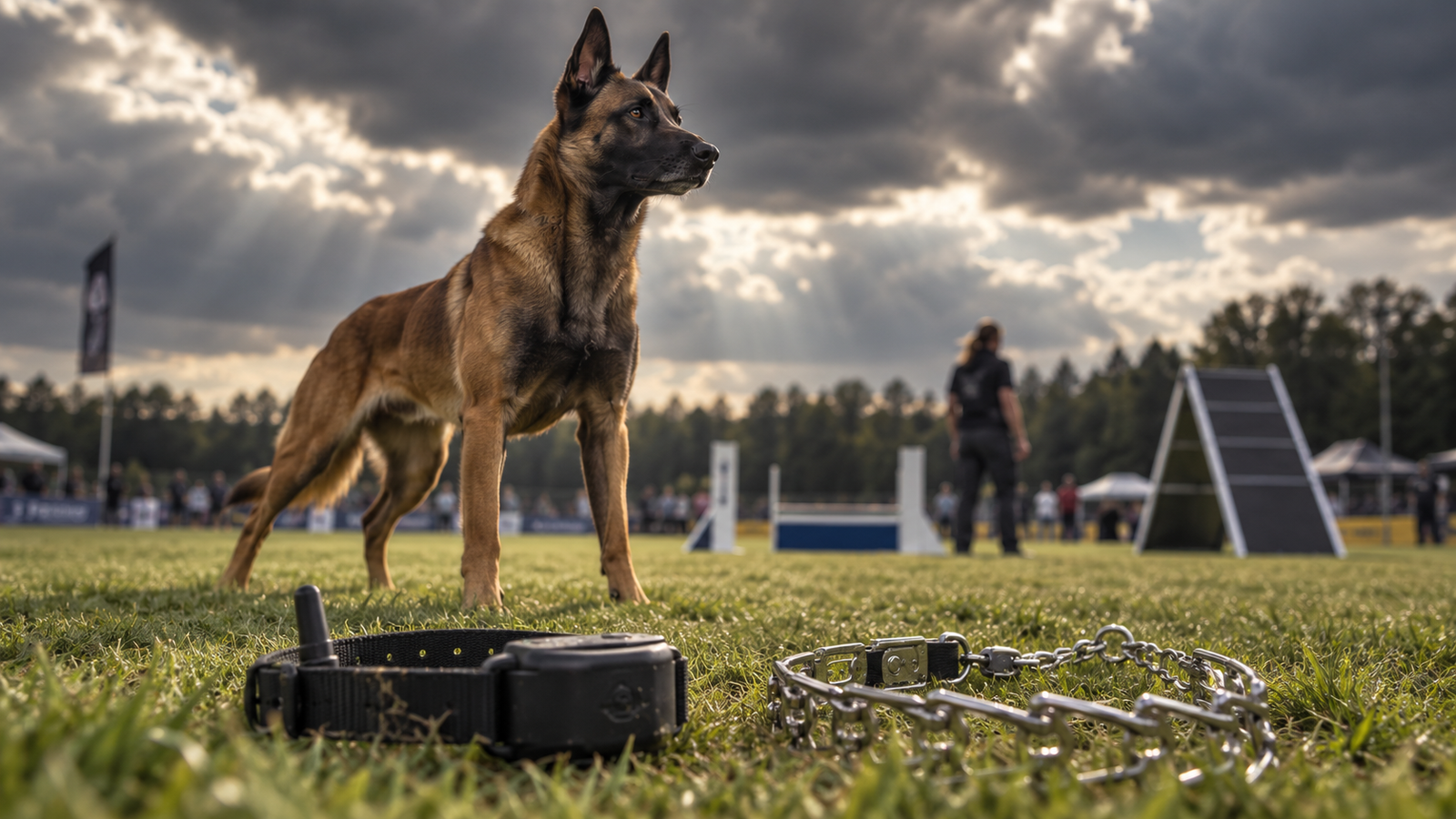
It is an open secret in our field that behind some impressive competition performances lie training processes involving considerable pressure. Perfect obedience, speed of execution, and the sight of a dog performing with mechanical precision do not necessarily reveal what it took to get there. In some cases, that journey includes coercion and the use of pressure-based tools to achieve the score that will put a person on the podium.
To be fair, I know people who are genuinely committed to dog sports, respect what dogs are capable of, and do not treat first place as an end in itself. For them, success cannot be separated from the methods used to achieve it.
But there is another side. It is the side where the dog becomes a means of personal validation, professional recognition, and commercial promotion. Where the result justifies almost everything, and the limits of pressure shift according to the ambitions of the person holding the leash.
Much is known within our field. We have witnessed practices, been in the same training facilities, and seen things that were never shown to the public. For years, a peculiar silence prevailed: a mutual tolerance that allowed everyone to preserve their public image.
Perhaps the greatest problem was never a lack of knowledge, but our inability to look at ourselves in the mirror.
Now, however, what is at stake is not which approach to training will prevail or who will gain greater influence. It is the dog’s future and its genuine welfare. That is why I have no reason to remain silent about what I have personally experienced. I am not referring to rumors or second-hand accounts, but to training practices I have seen with my own eyes.
There is also another aspect that is rarely discussed in public.
The dogs we admire at competitions for their temperament, obedience, and impressive performance do not necessarily show the same behavioral balance outside the competition arena. I have encountered dogs that performed impeccably in an event but, in everyday life, had serious difficulties managing stimuli and controlling their behavior.
Competition obedience is not proof of overall behavioral balance.
In many cases, it is the experience of the person handling the dog that reduces the likelihood of dangerous situations. A highly skilled professional may be able to manage a dog with intense temperament effectively, but that does not mean the dog has the balance that spectators may attribute to it.
It is like watching a race car with hundreds of horsepower and a stuck accelerator. An experienced driver may be able to keep it on the track and complete impressive laps. But that does not mean the car is functioning properly. It means someone has the skill to manage a problematic situation.
Likewise, a handler’s skill should not be confused with the behavioral balance of their dog.
I do, however, want to make one thing clear. I have supported dog sports, and I continue to believe in their value. I think it is important to keep much of the breeds’ working heritage alive. The endurance, concentration, willingness to cooperate, and distinctive working abilities shaped over generations should not disappear simply because today we primarily regard dogs as companion animals.
Sports can play an important part in preserving those traits. But not at any cost, and certainly not just because someone wants to add another trophy to their collection.
This is the essential difference between a necessary training intervention and the pursuit of a sporting distinction.
When you are called upon to address dangerous behavior that threatens a family or the dog’s own safety, you may need to apply proportionate pressure, within clear limits and with full responsibility for the consequences.
But when we are talking about sport, there is no comparable necessity. There is a human choice to enter a competition and a desire for a particular result.
What, then, is the ethical justification for subjecting a dog to intense pressure or coercion when the sole aim is a higher score?
I am not advocating a sport without effort, demands, discipline, or challenges. I am saying that every training method and every tool must be evaluated according to its purpose and its effects on the dog. Winning first place cannot be an excuse for practices we would otherwise consider unjustified.
Perhaps it is time to stop judging champions solely by what they show the judges. We should care just as much about the path they took to get there, and about the dog’s condition after the competition lights go out.
The value of cooperation between humans and dogs cannot be measured solely in points, trophies, and medals.
And if a dog must sacrifice its balance and welfare to reach the top, the question is not who won first place, but who ultimately paid the price.