
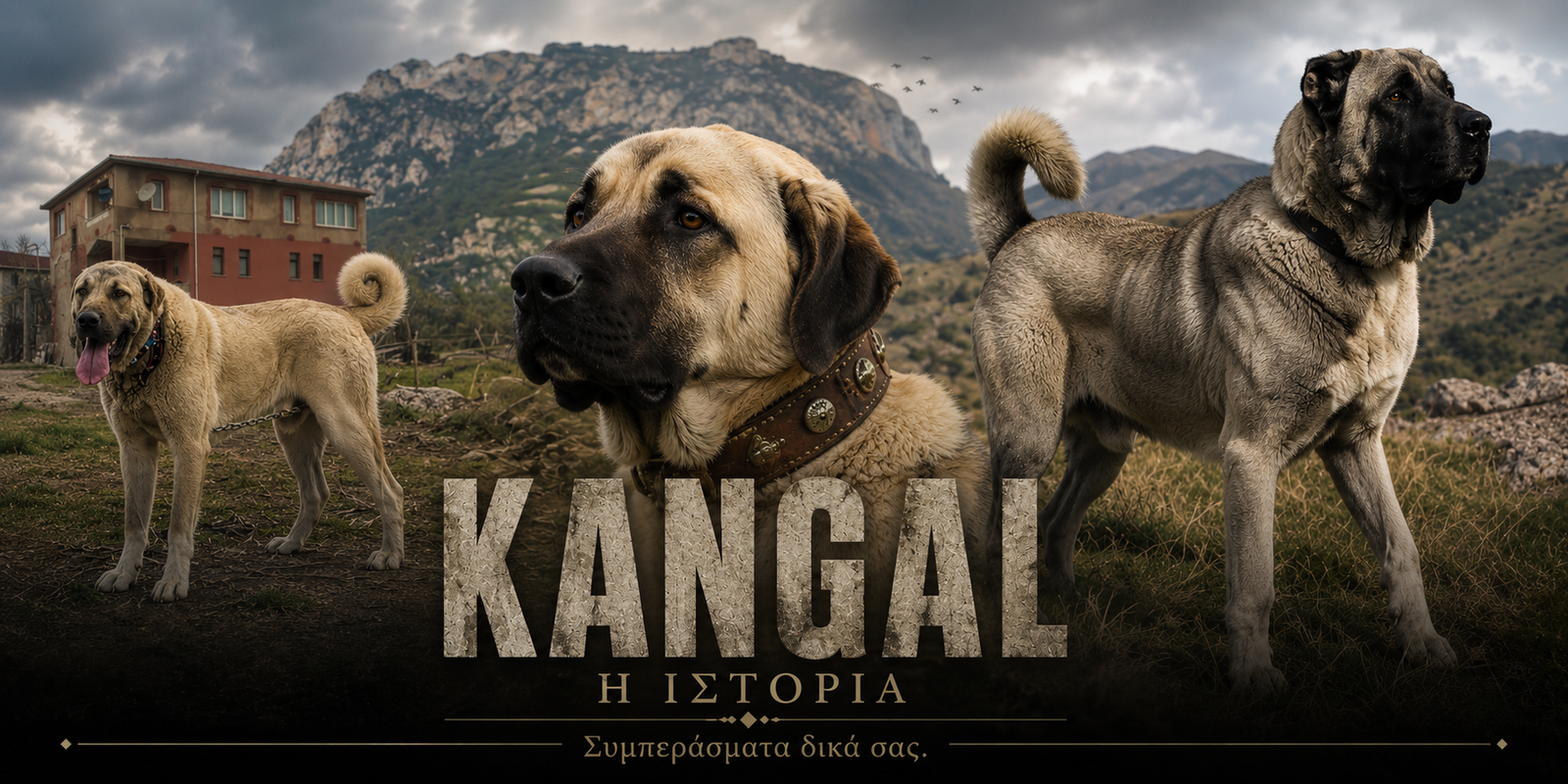

DOG’S MIND — DOG HISTORY & BREEDS
Kangal – How It Achieved Recognition
The history of the Kangal shows how a native dog breed can move from local tradition to institutional, scientific and international recognition.
There are times when comparing ourselves with a neighbour feels uncomfortable. Perhaps that is precisely why it can be useful. Today, the Kangal is one of Turkey’s most recognisable dogs: a large livestock guardian, inseparably connected with the Kangal district of Sivas Province and so deeply embedded in modern Turkish identity that the official Fédération Cynologique Internationale standard describes it as Turkey’s ‘national dog’.
If we stop there, however, we miss what may be the most interesting part of the story. The Kangal is not merely an old local breed that eventually gained international recognition. It is also an outstanding example of what can happen when protecting a native dog ceases to be the exclusive concern of a handful of breeders and gradually becomes a matter for institutions, science and the state.
This story is particularly relevant to us in Greece. Not because everything Turkish should be idealised, nor because Turkish breeders formed a harmonious family without conflict or competing views. Quite the opposite. The history of the Kangal includes disputes, rival concepts of the breed, controversy over the Anatolian Shepherd and conflicts that crossed Turkey’s borders. The crucial difference lies elsewhere: disagreement did not stop the objective.
Before the Kangal, there was the dog
When discussing ancient dog breeds, restraint is always necessary. Almost every old breed is accompanied by stories that take it back thousands of years—to ancient armies, empires and mythical molossers. The Kangal is no exception.
Turkish tradition includes accounts linking the large shepherd dogs of Anatolia with much earlier eras, the Ottomans and even older civilisations of the region. Yet the scientifically honest answer is different: we do not know the precise remote ancestry of the modern Kangal.
Even the current official FCI standard acknowledges this. Reconstructing the history of livestock guardian dogs with certainty is exceptionally difficult.
The most plausible broad picture connects the large shepherd dogs of Anatolia with dog populations that accompanied nomadic and pastoral societies for centuries. These dogs were not created for conformation shows, but for a very specific task: living with flocks and protecting them from real predators.
The Sivas region, and Kangal in particular, gradually became associated with a distinctive population of such dogs. This is essential to understanding the breed. The people of Anatolia did not begin with a written standard and then attempt to manufacture the appropriate dog. Function came first. The breed came later.
Environment, flocks, distances, predators and human selection shaped a functional population over generations. Much later, modern cynology attempted to describe that population using the tools of purebred breeding. That is precisely where the problems begin.
The Anatolian Shepherd paradox
In 1989, the Fédération Cynologique Internationale had already recognised breed number 331 as Çoban Köpeği, meaning ‘shepherd dog’, under the international name Anatolian Shepherd Dog.
It is therefore inaccurate to say that ‘Turkey managed to place the Kangal in the FCI in 2018’. The real story is more complex.
Western cynology had developed the concept of a broad Anatolian Shepherd: an Anatolian dog under whose umbrella different Turkish shepherd types could be grouped. A different view developed in Turkey. The Kangal, the Akbaş—literally ‘white head’—and other populations were not regarded simply as different appearances of one breed that the West could call the Anatolian Shepherd.
This was the beginning of a process that would last for decades.
The state enters the story
One of the most important developments appeared in the early 1990s. In 1992, the state organisation TİGEM—Tarım İşletmeleri Genel Müdürlüğü, the General Directorate of Agricultural Enterprises—began an organised programme for preserving and breeding Kangal and Akbaş dogs.
Kangals from the Sivas region were transferred to the state farm at Karacabey, where an organised selection process followed. From 1996 onward, dogs began to be distributed with certification and pedigree monitoring.
This matters for a simple reason. We are no longer dealing only with private individuals attempting to preserve a type of dog. The state itself is maintaining a breeding population.
Nor did this activity disappear once public interest faded. TİGEM state facilities continue to maintain Kangals as part of Turkey’s programme for protecting animal genetic resources.
1997: the dog receives a Turkish standard
The next critical step came in 1997. The Türk Standardları Enstitüsü, the Turkish Standards Institution, issued TS 12172 – Kangal Köpeği Standardı, the Kangal Dog Standard.
Twenty-one years before the final amendment of the FCI standard, Turkey already had its own official definition of which dog should be considered a Kangal.
This detail is more important than it may appear. Before asking an international body to accept that the Kangal is a specific Turkish breed rather than merely a variety of a general Anatolian Shepherd, a country must first be able to answer the question for itself: what exactly is a Kangal?
Turkey began to construct that answer institutionally.
From the breeder to legislation
At the beginning of the following decade, the process advanced further. Turkish legislation on the improvement of animal breeds explicitly introduced the need to protect the country’s local animal genetic resources.
The Kangal was named among the examples, alongside other characteristic Turkish animal populations. Exporting such genetic material could be made subject to authorisation by the competent ministry.
From this point onward, it becomes difficult to argue that this remained exclusively a cynological matter. The Kangal had begun to be treated as one of the country’s animal genetic resources.
The local community is not left out
At the same time, the Kangal district itself mobilised. Local government participated in registration initiatives, promotion of the breed and efforts to establish an institutional connection between the name Kangal and this specific dog.
A related application was recorded in 2001, and the process was officially publicised in 2002.
Here we see the formation of something that would prove decisive: local administration, state organisations, breeders and scientists were not necessarily doing the same work, but they were moving towards the same final destination—the preservation and official recognition of the breed.
2003: from tradition to science
In 2003, the first international symposium on the Kangal was held. At this point, the quality of the argument began to change.
It was no longer enough to say, ‘this is our dog and we have had it here for many generations’. The effort to produce scientific documentation had begun.
The symposium presented research on the breed’s history and morphology, and even on the potential use of molecular methods to investigate Kangal identity.
Research continued over the following years.
Can genetics distinguish the Kangal?
In 2005, a study with the telling title ‘Genetic evidence for the distinctness of Kangal dogs’ was published.
The researchers used 100 microsatellite genetic markers to compare Kangal, Akbaş, Turkish sighthounds and other dog populations.
The results supported the conclusion that the Kangal forms a genetically distinct population. Other mitochondrial DNA studies were carried out during the same period, and additional data were published in 2009.
In 2013, a broader study of genetic diversity among native Turkish dogs reached a particularly interesting conclusion: Kangal and Akbaş appeared as different genetic populations and, according to the authors, the general merging of Turkish shepherd dogs under the name ‘Anatolian’ or ‘Turkish Shepherd Dog’ did not accurately reflect the genetic reality they recorded.
Suddenly, the Turkish position regarding the Western Anatolian Shepherd was no longer supported by tradition alone. It also had scientific arguments.
A university centre dedicated to researching the breed
In 2005, Cumhuriyet University in Sivas established the Kangal Köpeği Araştırma ve Yetiştirme Merkezi—the Kangal Dog Research and Breeding Centre.
This was not a private club of breed enthusiasts.
The centre’s establishment and operation acquired institutional status through publication in the Turkish Official Gazette. Its objectives included preserving the Kangal through appropriate selection, studying its health, reproduction and living conditions, and transferring knowledge to public and private breeders.
By this point, almost the entire picture was in place: state farms, a national standard, local government, legislative protection, university research, genetic documentation and breeders.
One element was still missing: the organisation capable of carrying all of this into international cynology.
KIF and the creation of a national cynological strategy
The Köpek Irkları ve Kinoloji Federasyonu—KIF, Turkey’s Dog Breeds and Cynology Federation—was perhaps the decisive final element.
KIF did not limit itself to issuing pedigrees and organising dog shows.
Its statutes explicitly define as an objective the necessary work for native Turkish breeds that do not yet have an internationally registered standard to be recognised and registered internationally in Turkey’s name, with priority given to the FCI.
This represents a major change in scale. The international future of a native breed was no longer treated as the problem of that breed’s individual club. It became a mission of the national cynological organisation.
The Kangal acquired such a powerful symbolic role that its head appears in KIF’s own emblem.
But were there disputes?
Certainly—and here we must be entirely fair to the historical record.
There was no magical Turkish unanimity. Different views existed about which dog constituted a true Kangal, its relationship with other shepherd populations, which morphological characteristics should be accepted and, above all, the relationship between the Kangal and the Anatolian Shepherd.
The conflict became particularly intense abroad. Breeders and organisations that had bred Anatolian Shepherds for decades believed they already possessed an established breed with pedigrees extending across many generations. Opposing them were those who supported the Turkish position: that the Kangal was a specific breed and that the Anatolian Shepherd was essentially a Western construction that had merged different Turkish populations.
The disputes reached kennel organisations in Britain, Australia and other countries, and their consequences remain visible today.
The American Kennel Club, for example, continues to recognise the Anatolian Shepherd Dog. The FCI decision therefore does not constitute a universal scientific verdict that erased every other view. It represents the FCI’s official cynological position.
That distinction matters.
How, then, did they succeed?
Here lies, in my view, the most important lesson of the entire story.
They did not succeed because they stopped arguing. They succeeded because their arguments were not allowed to exercise a veto over the final objective.
Preserving the Kangal had already moved beyond the limits of a group of breeders. The state maintained a genetic population; a national standard existed; a legislative framework protected genetic resources; universities conducted research; genetic studies were available; there was a national cynological organisation; and there was now a specific international objective.
Breeders could continue to disagree, but the objective did not return to zero every time.
Turkey enters the FCI
KIF’s institutional development within the FCI is also instructive.
In 2015, Turkey was promoted from contract partner to associate member of the FCI. In 2017, KIF became a full member.
In 2018, what had been prepared for years finally happened.
On 15 June, the FCI General Committee approved a new standard for breed number 331. The former Çoban Köpeği / Anatolian Shepherd Dog was replaced by Kangal Çoban Köpeği—the Kangal Shepherd Dog.
The country of origin was now explicitly recorded as Turkey.
The new official standard was published on 25 June 2018.
An important point must be repeated. The Kangal did not suddenly appear in the FCI in 2018. Breed number 331 had existed since 1989 as the Anatolian Shepherd Dog.
What the Turkish side achieved was different and, in one sense, more difficult: it persuaded the FCI to abandon the previous international definition and accept the Turkish understanding of the breed’s identity.
After recognition, they did not simply say ‘everyone qualifies’
This is perhaps even more characteristic of the determination with which the new policy was implemented.
Following the 2018 change, a decision had to be made about Anatolian Shepherds that were already registered. KIF’s position was that such a dog could be registered as a Kangal if it met the new standard.
In other words, not every Anatolian Shepherd was automatically converted into a Kangal.
The change provoked objections, but the FCI had made its decision. Breed number 331 now referred to the Kangal.
And the state continued
In 2018, the then Minister of Agriculture and Forestry, Bekir Pakdemirli, visited the state facilities at Karacabey.
The ministry’s official announcement referred to the Kangal and Akbaş as important genetic resources of Anatolia and connected their state breeding programme with passing this heritage to future generations.
State facilities continue to breed Kangals. Research institutions continue to study the breed. KIF did not stop with the Kangal: the same approach is now being applied to other native Turkish breeds, including the Akbaş, Zerdava and Aksaray Malaklısı.
The Kangal was therefore not an isolated success. It formed part of a broader idea: native breeds represent animal, genetic and cultural capital for a country, and securing their international recognition is a matter of national importance.
And this is where we must look at ourselves
I am not writing this because I have suddenly developed a special admiration for Turkish state policy, nor to turn a dog into yet another episode of the endless Greek–Turkish rivalry.
Quite the opposite.
I am telling this story because a useful example exists beside us—and because we have dogs of our own that need protection.
We have the Greek Shepherd. We have the Molossus of Epirus. We have the Cretan Hound. We also have other Greek populations for which people have struggled for years.
And, of course, we have disagreements. Which is the correct type? Which standard is right? Which breeder has the best dogs? Which club truly represents the breed? Which president quarrelled with whom? Who left? Who founded another club? Who is right?
Perhaps, however, the history of the Kangal shows that we are asking the wrong question.
The Turkish side did not agree on everything either. At some point, however, the survival and international recognition of the breed became greater than any breeder, greater than any club and greater than any dispute.
The state did not need to decide which breeder had the largest ego. It needed to decide whether it regarded this specific genetic population as part of its heritage.
And it decided that it did.
It created infrastructure, maintained dogs, assigned scientists to study them, established a standard, protected genetic material, involved a university, built a cynological mechanism, joined the FCI and continued to the end.
That is the real lesson of the Kangal.
Not that Turkish people love their dogs more. Not that they have better breeders. And certainly not that they do not argue.
The lesson is much simpler: people can disagree about how something should be protected without disagreeing about whether it will ultimately be protected.
And perhaps this is the point at which our Turkish neighbour did something right.
Sources and bibliography
- Fédération Cynologique Internationale (FCI) — Official listing of the Kangal Shepherd Dog, standard number 331. Includes the country of origin, classification and the breed’s current status.
- FCI Standard No. 331 – Kangal Shepherd Dog — The complete current international standard. Particularly important for the official description of the breed’s historical origin, function and cultural significance.
- FCI, ‘Çoban Köpeği (331): change in the breed name and new standard’, 2018 — Official announcement of the name change and approval of the new standard on 15 June 2018.
- FCI / KIF announcement, 1 August 2018 — Guidance on implementing the new standard and converting dogs previously registered as Anatolian Shepherd Dogs.
- FCI Annual Reports 2015, 2016 and 2017 — Document KIF’s institutional development within the FCI and its acceptance as a full member in 2017.
- Köpek Irkları ve Kinoloji Federasyonu—Turkey’s Dog Breeds and Cynology Federation (KIF) — Official history and presentation of the Turkish cynological federation. Describes work on standards, genetic mapping and international recognition of native Turkish breeds.
- KIF Statutes — A particularly important primary source, since they define as a statutory objective the recognition and international registration of native Turkish breeds in Turkey’s name, with priority given to the FCI.
- TİGEM – Tarım İşletmeleri Genel Müdürlüğü, General Directorate of Agricultural Enterprises — Official information on state Kangal and Akbaş breeding programmes, the beginning of organised breeding at Karacabey in 1992, pedigree monitoring and the current protection of these populations.
- Ulaş Tarım İşletmesi—Ulaş Agricultural Enterprise / TİGEM — Official information on the preservation and breeding of Kangals in Sivas as part of Turkey’s protection of animal genetic resources.
- Tarım ve Orman Bakanlığı—Turkey’s Ministry of Agriculture and Forestry — Announcements concerning the preservation of Kangal and Akbaş dogs as important genetic resources of Anatolia and Minister Bekir Pakdemirli’s visit to Karacabey in 2018.
- Türkiye Büyük Millet Meclisi—Grand National Assembly of Turkey (TBMM) — Parliamentary documents concerning legislative protection of domestic animal genetic resources. The Kangal is named among characteristic local populations requiring protection.
- Türk Standardları Enstitüsü—Turkish Standards Institution, TS 12172 Kangal Köpeği Standardı, 1997 — Turkey’s national Kangal standard before the amendment of the international FCI standard.
- Kangal Kaymakamlığı—Kangal District Governorship — Historical information on the breed, local tradition, the 2001–2002 registration initiatives, and measures for protection and promotion.
- Sivas Cumhuriyet Üniversitesi Kangal Köpeği Araştırma ve Yetiştirme Merkezi—Kangal Dog Research and Breeding Centre of Sivas Cumhuriyet University — Official history of the university centre, founded in 2005 with institutionally defined goals for research, selection and preservation.
- TAGEM – Tarımsal Araştırmalar ve Politikalar Genel Müdürlüğü, General Directorate of Agricultural Research and Policies — Information on the national programme for recording and characterising native animal genetic resources and the use of morphological and molecular genetic methods.
- Altunok et al., ‘Genetic evidence for the distinctness of Kangal dogs’, 2005 — Genetic study using 100 microsatellite markers that supported the genetic differentiation of Kangals from other Turkish dog populations examined.
- Mitochondrial DNA studies of Kangal and Akbaş dogs, Middle East Technical University and related publications, 2005–2009 — Research into the genetic structure and relationships of native Turkish dogs.
- ‘Genetic variability among native dog breeds in Turkey’, Turkish Journal of Biology, 2013 — Study of 141 dogs using 20 genetic markers. It supported the distinction between Kangal and Akbaş and scientifically questioned the merging of different Turkish shepherd populations under a general Anatolian/Turkish Shepherd designation.
- Research on Kangal behaviour in working flocks, Applied Animal Behaviour Science, 2018 — Study of 24 working Kangals with flocks of 250–500 sheep, using satellite movement tracking among other methods.
- Royal Kennel Club, United Kingdom – Turkish Kangal Dog — A useful independent cynological source on the separate recognition of the Turkish Kangal in Britain and the historical dispute surrounding the Kangal and Anatolian Shepherd.
- American Kennel Club – Anatolian Shepherd Dog — Useful as a contrasting international case: the American system continues to recognise the Anatolian Shepherd Dog, demonstrating that the FCI decision did not eliminate the international cynological disagreement.
- Historical sources and proceedings of the 1st International Kangal Symposium, 2003 — Papers on the breed’s history, morphology, preservation problems and the application of molecular methods to its investigation.
Christos Koutsis
Dog Trainer