

DOG’S MIND — ARTICLES
Dog Aggression and Human Fear
Human fear and everyday reactions can shape what a dog learns—even when we do not realise it.
Those who have worked on training a guard dog may know that, in the early stages, if the relevant behaviour has not yet emerged, a trainer may try to bring it out.
I will not go into the technical details. There is always the risk that someone will decide to improvise, believing that a written account is enough to understand such a complex process.
I do, however, want to focus on one characteristic movement that may occur in this context: stepping back.
The person assesses the dog’s posture and response, then chooses to move away. We could describe this as acknowledging the strength the dog is displaying at that moment and deciding not to continue approaching.
Within the right learning context, this seemingly insignificant movement can take on particular importance.
After all, in nature, it does not always take a major confrontation to determine how an interaction unfolds. A change in posture, a glance, a retreat or a sudden movement can convey information and influence what happens next.
Let us consider something else as well.
A dog chasing a cat does not necessarily do so because it sees the cat as an enemy. Very often, the act of fleeing itself is the stimulus that triggers the chase.
And this is where I want to share a story from my own professional experience.
A Rottweiler and a few seconds that changed everything
Among the dogs I trained was a Rottweiler who was truly enormous, even as an adolescent.
He was an impressive animal in size and strength, yet also exceptionally sweet and sociable.
His training was progressing with remarkable ease. Cooperative, willing and responsive to rewards, he enjoyed being petted and interacting with people. He had shown no signs of aggressive behaviour.
Until one day, at the home where he lived, something seemingly insignificant happened.
The front door had accidentally been left slightly open.
Just then, the postman arrived. He noticed the open door and gently pushed it, simply intending to alert the people inside.
And there, facing him, was the enormous Rottweiler.
The man was frightened.
And he started to run.
For a few seconds, the dog seemed to be trying to understand what was happening. Perhaps the sudden reaction took him by surprise.
Then he gave chase.
There had been no confrontation. The man had not threatened him. The postman had made no attempt to provoke the animal.
He had simply been afraid.
And that fear had expressed itself in a sudden flight.
From that day on, the dog’s behaviour changed. In my experience, that incident marked a turning point in the development of his behaviour, with consequences that extended beyond that particular moment.
We cannot know with certainty exactly what happened in the animal’s brain during those few seconds. But we can understand that an intense experience can carry considerable weight in learning.
And that is the heart of this story.
It is very easy to tell someone, “Don’t show fear.” It is almost impossible to expect a person who is genuinely afraid to stop feeling afraid just because you told them to.
The postman did not need a lesson in courage. He needed never to have been put in that position.
And that is, first and foremost, a matter of prevention and human responsibility.
Fear as part of the training we do not see
So the question is this:
Could some aggressive behaviours be shaped, among other things, by small, repeated lessons in human fear?
Lately, I have kept returning to the distorted image of the dog presented through social media.
We have reached the point of portraying an animal with powerful instincts, particular needs and a real capacity to cause injury almost exclusively as an inexhaustible source of love and emotional fulfilment.
Man’s best friend!
A wonderful phrase. But when it becomes a commercial promise, it can create entirely false expectations.
What happens when someone who expected to welcome their best friend into their home suddenly hears a growl?
A growl they did not expect. A reaction they had never imagined. A moment when fear comes before thought.
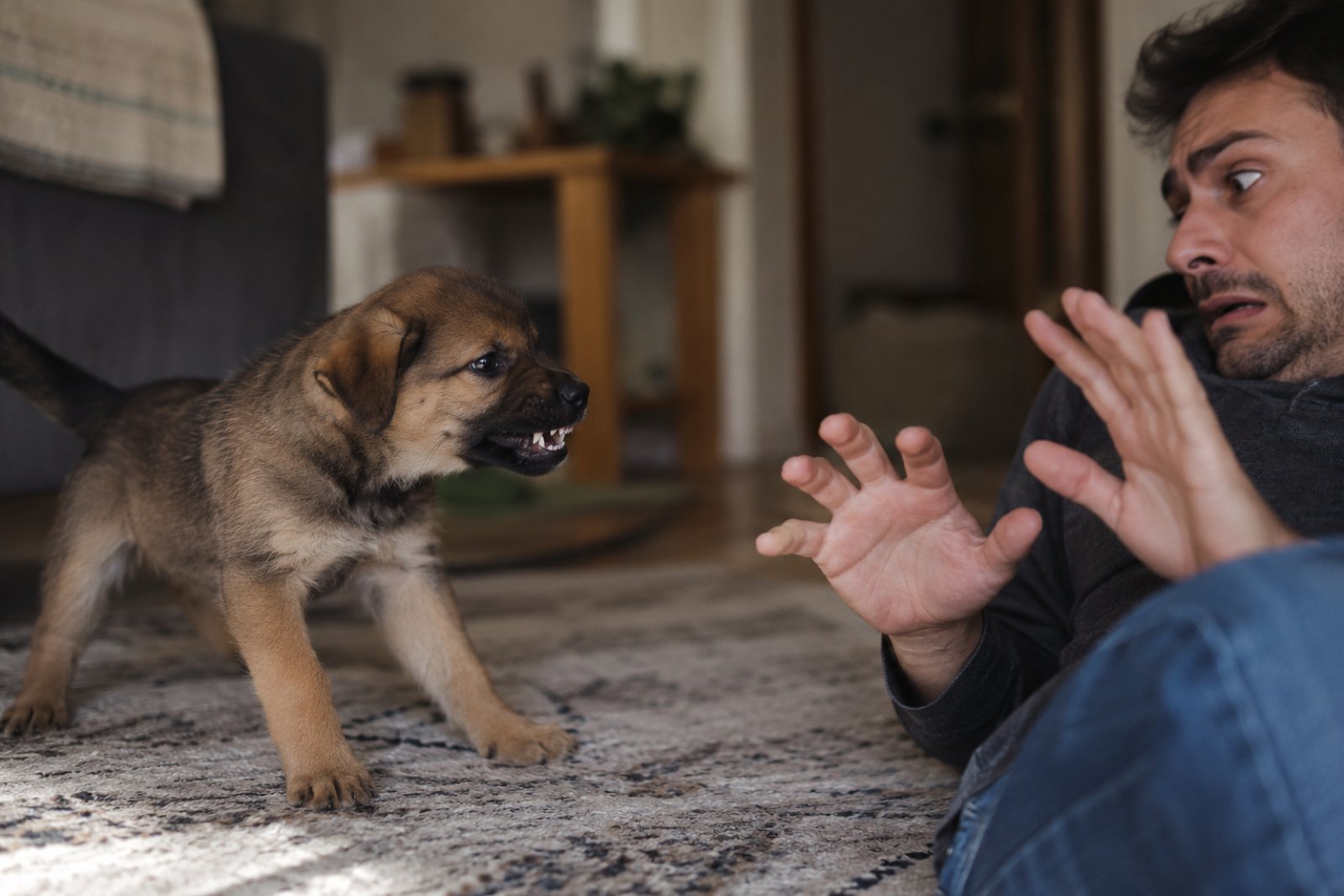
Hands are snatched away. The body recoils. The voice changes. The person becomes upset, confused and reacts erratically.
The dog, however, does not hear the explanations we later give ourselves. The dog perceives what happens in that moment and learns from its consequences.
This does not mean that stepping away from a growling dog is always a mistake. Growling is a warning signal, and moving away safely may be absolutely necessary.
The problem begins when a sequence of reactions is repeated without the person understanding what is happening or taking the right steps to manage it.
Training does not happen only when we decide to train our dog. It also happens in the moments when we do not realise we are teaching them something.
Take a simpler example: puppy biting.
If a person cannot control the movements of their hands, if every contact with the puppy’s teeth brings panic, abrupt reactions and complete confusion, everyday interaction can turn into a series of unintended learning experiences.
That does not mean a puppy becomes aggressive because someone was afraid. It does mean, however, that our own behaviour plays an active part in shaping theirs.
The human emotional state everyone forgets
And this brings us to something I believe is missing from much of the public discussion about dog training.
The human being’s emotional state.
We are surrounded by theories, scientific references, methodologies and endless arguments about what is and is not acceptable in training.
On one side are people who view almost any form of boundary-setting with suspicion. On the other are people who still regard imposing their will as the obvious answer to every problem.
And somewhere in the middle is a real person: someone who lives with their dog and may feel fear or anger, be caught off guard, or lose their composure.
How many people truly pay attention to them?
How many trainers ask not only what the dog needs to learn, but also what the person beside the dog is emotionally capable of handling?
Emotion does not disappear because someone has explained, in theory, that we should not be afraid.
Fear cannot be erased with an instruction.
It takes understanding, familiarity, knowledge and practical preparation.
And here I will raise another concern, knowing that it may make some people uncomfortable.
I see a society that, in the name of certain supposedly “higher” values, increasingly cultivates the expectation that every unpleasant emotion, every difficulty and every conflict should disappear from our lives.
Sensitivity is presented as a virtue, as indeed it can be. But when it is not accompanied by the ability to handle difficult situations, there is a risk that it will turn into emotional fragility.
More seriously, the speed at which human attitudes change does not mean that a dog’s biology changes at the same pace.
Dogs do not change behaviourally at the rate our social theories change.
A dog does not know what is politically correct. A dog has not followed trainers’ arguments on social media. A dog has no interest in the image we wish to project.
Dogs respond according to their biology, temperament, previous experiences and what they learn from their environment.
And that is precisely what we must respect.
Responsibility is not a pretty phrase on social media
I recently wrote the article “A Dog Never Bites the Hand That Feeds It!”, wanting to show how dangerous some deeply rooted beliefs can become.
Because a dog can bite even the hand that feeds it.
And if someone finds that possibility unthinkable, they may be completely unprepared when faced with such a situation.
There is nothing wrong with loving your dog. The mistake is believing that love overrides the dog’s biology, instincts, limits of tolerance and capabilities.
Especially with large, powerful or particularly energetic dogs, responsible care cannot be reduced to good food, walks and photographs on social media.
It takes seriousness. It takes consistency. It takes composure.
And we finally need to understand that guidance is not synonymous with violence, just as setting boundaries is not synonymous with punishment.
Being able to manage a situation does not mean using force to impose your will. It means knowing how to prevent escalation, how to protect yourself and your dog, and how to create the conditions for a stable relationship.
Even the term “companion animal,” in my personal opinion, can be misleading when it is used in a way that diminishes everything beyond the emotional bond with a human being.
A dog does not cease to be a dog because we have decided to call them our companion.
And genuine companionship does not require us to deny the dog’s nature.
Smiles are lovely. Kind words are lovely too. Scientific studies are also extremely useful when they are evaluated and applied properly.
But when you address people who take responsibility for an animal capable of causing serious injury, you, too, have an obligation to speak about the real risks.
Not only about what your audience likes to hear.
Nor is it enough to cite the results of studies conducted under controlled conditions without explaining the possibilities and limitations of applying those findings in everyday life.
Because everyday life is not a controlled experiment.
A postman may open a door. A child may make a sudden movement. A person may become afraid.
And a dog may react in a way no one anticipated.
Aggressive behaviour does not always have a history of abuse behind it. Nor is there always a genetic predisposition. Nor is there always a traumatic event or a difficult temperament.
Many factors may interact. Among them may be the human being’s own reactions, which, over time, can take on significance in the dog’s learning.
It is time, then, to stop treating the guardian solely as someone who must memorise a method.
We need to help them understand the animal before them: to recognise the dog’s warning signals, respect the dog’s limits, and safely establish boundaries for their shared life.
Ultimately, we need to educate the human being as well.
And perhaps we need to redefine what it means to be a responsible dog guardian.
It does not mean never being afraid.
It means knowing the capabilities of the animal in your care, recognising your own limitations and making sure they do not become a danger to the dog, to you or to someone else.
Because dogs do not learn only from our commands. They learn from our movements, from our reactions and from what happens when we lose control.
And perhaps our greatest mistake is constantly looking for what the dog learned incorrectly without asking what, exactly, we taught them.
Responsibility for a powerful dog does not begin when aggression appears. It begins long before that, while we still believe there is no reason to be concerned.
One last thought… On the grandeur of nature
Recently, I heard an interview in which someone referred to the successful use of positive reinforcement even with tigers and crocodiles.
I will not comment on that particular statement.
But I will point out something I believe we need to understand.
When time is not pressing, the environment is controlled, and you can arrange the conditions, repeat a process as often as necessary and work within a research setting, you may well achieve impressive results.
To put it with a touch of exaggeration, perhaps one day you could even teach a snake to do somersaults in the air!
So what?
What, exactly, have you demonstrated about a person’s ability to manage a powerful animal safely once the conditions are no longer controlled?
Of course, a scientific study can establish what it actually examines. But an impressive result cannot automatically be turned into a general conclusion about every animal, every person and every situation.
In nature, we have seen things that seem unbelievable: wild animals caring for animals of other species, predators tolerating their prey, even instances of adoption or nursing between species that would normally have a very different relationship.
Nature can continually surprise us.
But that does not mean the exceptional is the rule.
And here, in my view, lies a major problem of our times.
We like to select the images from nature that confirm our beliefs: the ones that move us, make an impression, and attract smiles and approval.
But when we decide to speak of the grandeur of nature, we have a duty to ask which image we choose to represent it.
If we believe that nature’s grandeur can be summed up by the image of a sheep suckling from a lioness, and forget that the same lioness is an immensely powerful predator, then something is wrong with the way we understand the natural world.
Nature is no less remarkable when a wolf hunts its prey. It is no less beautiful when a dog expresses its instincts. It does not become less worthy of our respect because it does not behave according to our human moral expectations.
The grandeur of nature is found not only in the exceptions that move us, but also in the realities we often find difficult to accept.
And finally, let us not forget the most important thing.
Talking about how an animal can be trained is entirely different from personally taking responsibility for what you advocate.
Because when theory meets reality, there will not always be someone in a controlled environment, with unlimited time, ready to adjust the conditions of the experiment.
There may simply be a person standing in front of a dog.
And in that moment, impressive claims, smiles, followers and approval will not matter.
What will matter is whether that person understands the animal before them and is genuinely prepared to take responsibility.
Because admiring the power of nature is one thing; being able to manage it is quite another.